Quick Answer
Seat covers can be safe in Toyota vehicles with seat-mounted side airbags — but only when the cover has a vehicle-specific breakaway seam aligned with Toyota’s factory airbag deployment path. An incompatible cover can block, delay, or misdirect a side airbag during a collision. The phrase “airbag compatible” on a product label is not a safety guarantee on its own.
Key Takeaways
- Most Toyota vehicles built after 2012 have side airbags built into the front seat bolsters.
- A seat cover without a properly positioned breakaway seam can interfere with airbag deployment.
- Universal-fit covers are not recommended for Toyota front seats with seat-mounted SRS airbags.
- No federal standard in the US specifically requires seat covers to be tested for airbag compatibility.
- Always verify compatibility using your owner’s manual and manufacturer testing documentation.
1. Why This Safety Issue Matters
A seat cover seems like a straightforward upgrade — it protects the upholstery, adds comfort, and refreshes a worn interior. The safety implications don’t come to mind for most Toyota owners.
The problem is that Toyota builds side-impact protection directly into the front seats across most of its modern lineup. These seat-mounted airbags inflate in milliseconds during a side collision, creating a barrier between the occupant’s torso and the door. A seat cover over that deployment zone — without a correctly engineered breakaway panel — can physically resist that inflation.
An airbag that deploys late, partially, or in the wrong direction provides less protection than one that works as designed. In a side-impact crash, that difference matters.
2. Which Toyota Models Have Seat-Mounted Airbags?
Seat-mounted side airbags are built into the outer bolster of the front seatback — the raised section closest to the door. They appear across Toyota’s current and recent lineup, including the Camry, RAV4, Corolla, Tacoma, Highlander, 4Runner, Sienna, Tundra, Venza, Crown, Corolla Cross, RAV4 Prime, and bZ4X.
If your Toyota was built after approximately 2012, assume the front seats contain seat-mounted side airbags unless your owner’s manual or seat labels say otherwise.
One important distinction: seat-mounted side airbags are different from curtain airbags. Curtain airbags deploy downward from the roofline to cover the windows. They are not located in — or affected by — seat covers. Only seat-mounted airbags require this compatibility consideration.
3. How the SRS Airbag Deploys — and Why Seat Covers Matter
SRS stands for Supplemental Restraint System. The airbag is supplemental—it works with the seatbelt, not instead of it.
During a qualifying side collision, crash sensors trigger the inflator. Non-toxic gas rapidly fills the airbag, which bursts outward through a factory-sewn release seam in the outer seatback bolster. From impact detection to full inflation takes roughly 30 milliseconds.
That release seam is the critical detail. Toyota engineers the seat upholstery with a specific seam designed to split at exactly the force the deploying airbag generates. It controls where the airbag exits and the angle it inflates toward the occupant.
Any seat cover over this seam must allow the airbag to pass through at the correct location and angle. A cover that uses heavy stitching across the deployment path, lacks a release seam, or has a seam positioned at the wrong location introduces resistance where none should exist.
4. What Makes a Seat Cover Genuinely Airbag Safe?
Not every cover labeled “airbag compatible” has been properly engineered. Genuinely safe covers share these characteristics:
Vehicle-specific seam alignment. The breakaway seam must align precisely with the factory airbag deployment seam on your exact Toyota model, year, and trim. Seat geometry differs across models and generations — a seam positioned for a 2019 RAV4 may not align correctly on a 2024 model.
Correct thread weight. The release seam uses lighter thread than the structural seams. That thread must break at the correct deployment point—not too early and not too late.
Separate bolster panel construction. The airbag zone should be a distinct panel, able to separate independently when the airbag deploys.
Live deployment testing. The manufacturer should have tested the cover using actual airbag deployments on the specific Toyota model — not a generic seat or a different vehicle.
5. Common Mistakes Toyota Owners Make
Treating the label as proof. “Airbag compatible” on a listing does not confirm the cover was tested on your Toyota or that the seam is correctly placed.
Using universal-fit covers on front seats with airbags. Universal covers cannot account for each Toyota’s seat geometry and airbag seam location. They are a poor choice for any front seat with a seat-mounted SRS airbag.
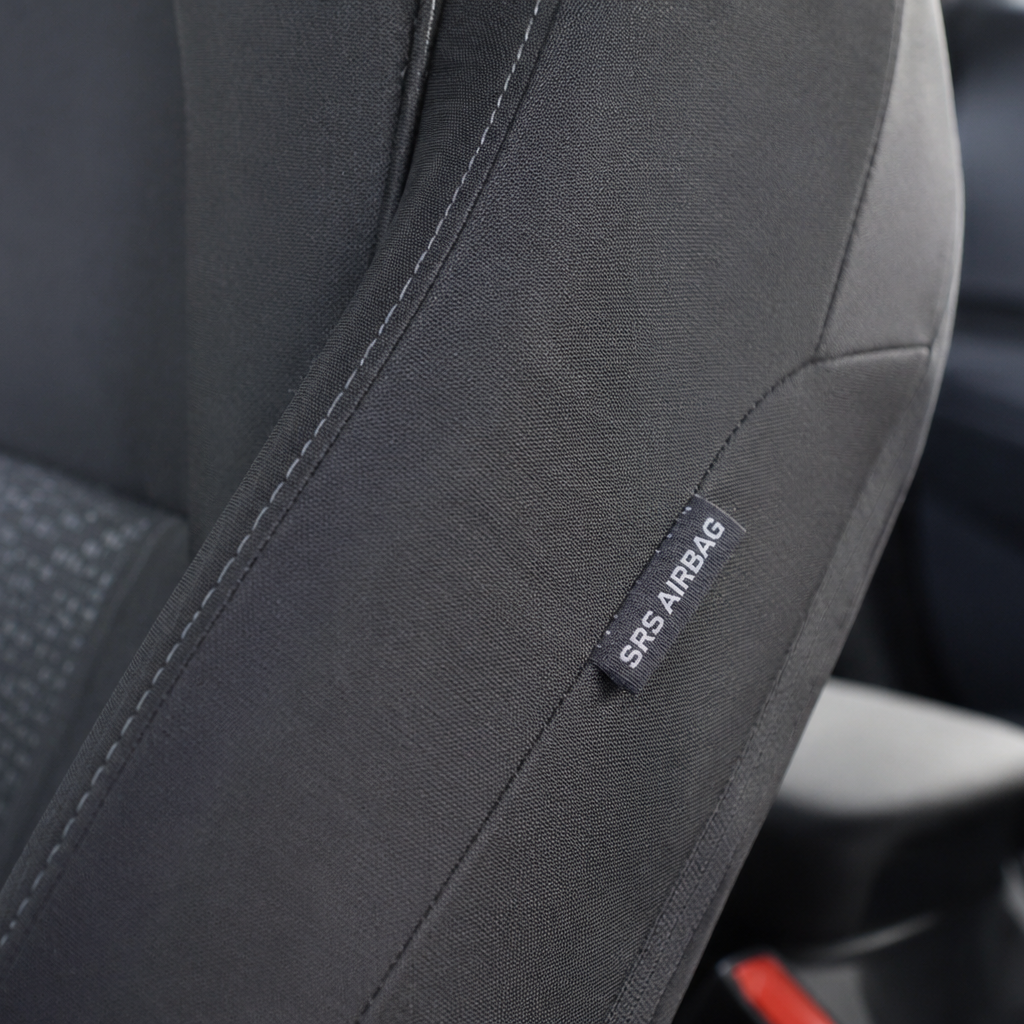
Cutting a slit at the SRS label. The SRS label on the seat marks the airbag location — not the exact deployment seam. The deployment seam runs along the forward-facing edge of the outer bolster. A cut at the label may not align with where the airbag actually exits.
Ignoring the occupancy sensor. Many Toyota front passenger seats contain an Occupant Classification System (OCS) sensor in the seat cushion that determines whether and how strongly the front passenger airbag should deploy. Thick seat cushion covers can alter the weight readings this sensor detects, which affects airbag response in a crash.
Overlooking rear seats. Some Toyota models — including the Sienna — have seat-mounted airbags in the second row. Those seats require the same compatibility evaluation as the front seats.
6. How to Verify Compatibility Before Buying
- Confirm seat-mounted airbags are present. Check the SRS label on the outer seat bolster and review the SRS section of your Toyota owner’s manual.
- Identify the deployment seam. The airbag exits through the forward-facing seam on the outer seatback bolster. The Insurance Institute for Highway Safety (iihs.org) publishes crash test imagery that can show this seam location for many Toyota models.
- Ask the manufacturer directly. Request: Was this cover designed and tested for my exact Toyota model, year, and trim? Does the breakaway seam align with the factory deployment seam? What testing was conducted, and at which facility?
- Inspect the cover before installation. Hold the cover against the seat and check that the release seam aligns with the factory deployment seam — not just the general bolster area.
7. Myths vs. Facts
Myth vs. Fact: Airbags are strong enough to rip through any cover. Deployment timing and direction are still compromised even if the airbag eventually tears through. Cutting a slit at the SRS label is enough. The label marks the airbag, not the deployment seam—misalignment remains a risk. Universal covers with an airbag tag are safe. A tag does not confirm vehicle-specific seam alignment or live deployment testing. A federal standard requires seat covers to be tested for airbags. NHTSA has confirmed no federal standard specifically governs aftermarket seat covers and airbag compatibility.
8. Frequently Asked Questions
Can I use seat covers on a Toyota RAV4 with side airbags?
Yes—but only a cover designed specifically for your RAV4 generation, with a confirmed breakaway seam aligned to the factory airbag deployment seam. Universal covers are not appropriate.
Does the SRS label tell me exactly where the airbag deploys from?
No. The label confirms the airbag is present in that seat. The actual deployment seam is the forward-facing edge of the outer bolster—and that is where the seat cover’s breakaway seam must align.
Is there a federal certification for airbag-safe seat covers?
No. NHTSA has confirmed there is no federal standard requiring seat cover manufacturers to test for airbag compatibility. No government certification program exists. The responsibility for verification falls on the buyer and the manufacturer.
Can a seat cover void my Toyota warranty?
A seat cover alone does not automatically void your warranty. Under the Magnuson-Moss Warranty Act, a manufacturer generally cannot void a warranty solely because an aftermarket part was installed. However, if a cover is found to have caused damage to a warranty-covered system — such as the airbag — Toyota may decline coverage for that specific damage.
Summary
Toyota’s seat-mounted SRS airbags are part of a precisely engineered safety system. A seat cover placed over that system needs to be designed with the same precision: vehicle-specific breakaway seam alignment, correct thread weight, separate bolster panel construction, and confirmed live deployment testing.
“Airbag compatible” is a starting point, not a conclusion. Checking your owner’s manual, understanding where the deployment seam sits on your specific Toyota model, and asking manufacturers for documented testing results are the steps that actually confirm safety.