
Smart, Automatic, and Built for Longevity
Introduction
A dead battery is one of the most avoidable problems in vehicle ownership — and one of the most common. If you store a car seasonally, ride a motorcycle in summer only, or own a boat that sits docked for months at a time, your 12V battery is quietly losing charge every single day it sits idle. By spring, you’re either jumping on it or replacing it.
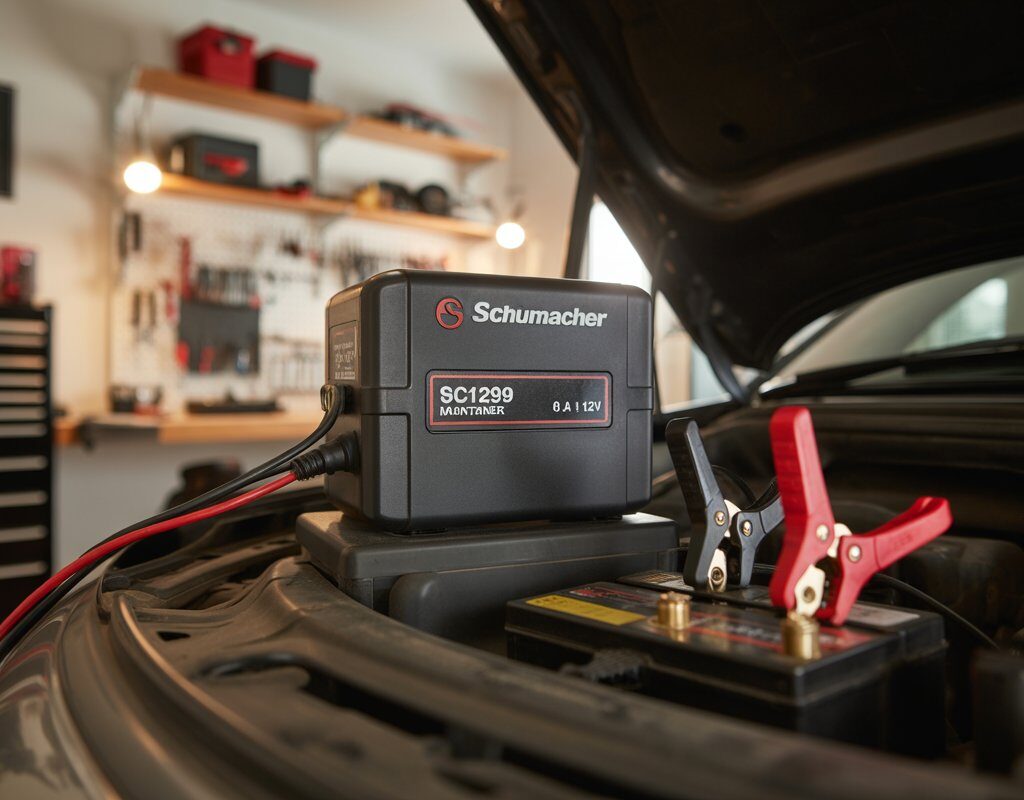
The Schumacher SC1299 is designed specifically to prevent that scenario. It’s a compact, microprocessor-controlled charger and maintainer that charges your battery initially, then holds it at optimal voltage indefinitely—without overcharging, without manual intervention, and without damaging the cells.
This 2026 review breaks down exactly what the SC1299 does well, where it falls short, and who it’s actually built for.
Quick Answer
The Schumacher SC1299 is a 0.8-amp, 12V smart battery maintainer ideal for seasonal vehicles, stored classics, powersport equipment, and marine batteries. It charges automatically, switches to float mode when full, and can stay connected indefinitely without overcharging. It’s not designed for fast recovery of deeply discharged batteries — for that, you need a higher-amp unit.

- 2-in-1 Device – Charges and maintains batteries
- Immediate Charging Power – Delivers 0.8-amp charging and maintaining
- Smart Trickle Charge – Maintains 12V batteries safely over time without overcharging

Comparison Table: SC1299 vs. Similar Maintenance Chargers
| Unit | Output | Battery Types | Best For | Price |
|---|---|---|---|---|
| Schumacher SC1299 | ~0.8A | Lead acid, AGM, gel | Storage & long-term maintenance | ~$19 |
| NOCO GENIUS1 | 1A | 6V/12V, AGM, lithium | Light maintenance + 6V compatibility | ~$30 |
| Battery Tender 3A | 3A | Lead acid, AGM | Faster recovery + maintenance | ~$70 |
Bottom line: The SC1299 wins on price and simplicity for pure maintenance. Step up to the Battery Tender if you need faster initial charging.
Schumacher SC1299: Full Expert Review
Technical Specifications
| Spec | Detail |
|---|---|
| Output Voltage | 12V DC |
| Output Current | ~0.8A |
| Input | 120V AC |
| Dimensions | 2.88″ D × 3.13″ W × 8.63″ H |
| Weight | ~0.7 lb |
| Battery Compatibility | Standard lead acid, AGM, gel cell |
| Safety Features | Reverse polarity protection, LED status indicators |
| Charging Stages | Multi-stage: charge → absorption → float |
How the Multi-Stage Charging Process Works
The SC1299 doesn’t just push current into a battery until it’s full. Its microprocessor runs a three-stage sequence that mirrors how professional battery management systems operate:
Stage 1 — Bulk Charge: The unit delivers maximum output (0.8A) to bring the battery up from its depleted state as efficiently as possible at this amperage.
Stage 2 — Absorption: As the battery approaches full capacity, the charger reduces current while holding voltage steady. This prevents cell stress and reduces gassing—an issue with cheaper single-stage chargers that can damage AGM batteries over time.
Stage 3 — Float/Maintenance: Once the battery reaches full charge, the SC1299 drops to a holding voltage that keeps the battery topped off without pushing excess current through it. This is the mode it stays in indefinitely.
For storage applications, that float stage is everything. It’s what separates a battery maintainer from a basic charger, and it’s the core reason the SC1299 earns its place in a serious vehicle owner’s toolkit.
For context on AGM battery chemistry and why float voltage matters for longevity, Yuasa’s AGM battery guide is worth reading before you buy any maintainer.
Key Features That Matter
Automatic 2-in-1 operation. The SC1299 transitions from charger to maintainer without any input from you. Connect it, plug it in, and walk away. This is genuinely useful for people who store vehicles in garages without wanting to remember to disconnect anything.
Broad battery compatibility. One unit covers standard flooded lead-acid, absorbed glass mat (AGM), and gel cell batteries. That means a single SC1299 can handle your car, motorcycle, ATV, and boat—you don’t need separate maintainers for each.
Reverse polarity protection. If you connect the clamps incorrectly (red to negative, black to positive), the unit shuts down instead of frying the battery or itself. For anyone who doesn’t do this regularly, that protection is genuinely valuable.
Lightweight and compact. At under a pound and smaller than most paperback books, it stores easily in a garage cabinet, tool drawer, or even a trunk. The ring terminal adapter included lets you leave a semi-permanent connection point on the battery for faster hookup.
Pros
Cons
Ideal Buyer
The SC1299 is the right tool if you check any of these boxes: you store a vehicle for more than 30 days at a time, you own seasonal equipment like a motorcycle, snowmobile, or boat, you have a classic or collector car that doesn’t get driven regularly, or you want a cheap, reliable way to keep a backup or emergency vehicle ready to start.
It is not the right tool if your battery is deeply discharged and you need it ready in a few hours or if you’re dealing with a high-capacity battery (above 100 Ah) that needs meaningful recovery current.
Real-World Performance: What Owners Actually Report
Across hundreds of verified reviews on Northern Tool and Amazon, the SC1299 consistently draws the same feedback pattern: it works exactly as described for storage and maintenance use cases, and it disappoints only when buyers expect more amperage than the specs provide.
Common praise centers on winter storage performance—vehicles that sat for four to six months connecting immediately on spring startup. Common criticism comes from users who expected the 0.8A unit to recover a heavily discharged battery in a few hours. That’s a spec mismatch, not a product failure.
One pattern worth noting: many experienced users run a higher-amp charger (2–6A) for initial recovery of a depleted battery, then switch to the SC1299 for long-term maintenance. That two-unit approach covers both scenarios without overspending.
Buying Guide: What to Look For in a Battery Maintainer
Amperage vs. use case. For pure maintenance of a healthy battery, 0.8–1A is sufficient and safer than higher outputs. For recovery of discharged batteries, 2–6A is more practical. Know which you primarily need before buying.
Battery chemistry compatibility. AGM batteries are increasingly common in modern vehicles and are more sensitive to overcharging than flooded lead-acid batteries. Confirm any maintainer you buy explicitly supports AGM — the SC1299 does.
Float mode quality. Not all “maintainers” truly float—some just cycle on and off. A genuine float-mode maintainer holds a precise voltage continuously. The SC1299’s microprocessor manages this properly.
Safety features. Reverse polarity protection, spark-free connection, and overcharge protection aren’t optional features — they’re what separate a safe maintainer from a fire hazard. The SC1299 includes all three.
Connection options. Ring terminal adapters allow a semi-permanent connection point that makes connecting and disconnecting the maintainer a 10-second process. The SC1299 includes this.
For more on maintaining your vehicle’s electrical system alongside battery care, our guide on new automotive accessories covers complementary tools worth adding to your setup.
5 Common Mistakes Battery Maintainer Buyers Make
1. Buying a maintainer when they need a charger. A 0.8A maintainer will eventually charge a dead battery—but it might take 24–48 hours. If you need fast recovery, pair it with a higher-amp charger first.
Fix: Match amperage to your actual use case. Maintainer for storage, charger for recovery.
2. Not checking battery chemistry compatibility. Using a standard lead-acid charging profile on an AGM battery can reduce its lifespan significantly over time.
Fix: Confirm the maintainer explicitly lists AGM compatibility — the SC1299 does.
3. Ignoring the battery’s state before connecting. A maintainer cannot recover a deeply sulfated battery. If the battery won’t hold charge at all, the maintainer will run indefinitely without meaningful effect.
Fix: Test battery health with a load tester before deciding whether to maintain or replace.
4. Leaving corroded terminals connected. A maintainer connected to corroded terminals charges less efficiently and can cause heat buildup at the connection point.
Fix: Clean terminals before connecting. For a practical guide on vehicle connection maintenance, see our article on how to clean car seat covers—which also covers general interior and connection hygiene.
5. Storing the vehicle without any maintainer at all. A fully charged 12V battery loses roughly 1% of its charge per day at room temperature — faster in heat, slower in cold. After three months, it may be too discharged for the alternator to fully recover it.
Fix: A $19 maintainer is considerably cheaper than a replacement battery.
Expert Tips From Experienced Vehicle Owners
Use the ring terminal adapter. Instead of clamping directly to the battery every time, install the ring terminal adapter permanently and run the pigtail to an accessible location. Connecting the maintainer becomes a 10-second job rather than a 5-minute process.
Don’t skip the initial charge on a deeply depleted battery. If your battery reads below 11.5V, use a 2–4A charger to bring it back to 12V+ before switching to the SC1299 for maintenance. The low amperage will eventually get there, but it’ll take much longer.
Check your battery’s health annually. A maintainer keeps a healthy battery healthy — it doesn’t fix a failing one. Have your battery load-tested each fall before winter storage. Most auto parts stores do this free.
Label your connection point. If you store multiple vehicles, label the ring terminal pigtails with the vehicle name. It sounds trivial until you’re in a dim garage trying to remember which connector belongs to which bike.
FAQ
Q: Can the SC1299 be left connected to a battery indefinitely? A: Yes. The float maintenance mode holds the battery at optimal voltage without pushing excess current through the cells. It’s specifically designed for indefinite connection during storage. This is the primary use case the product is built for.
Q: Will it work on AGM batteries? A: Yes — the SC1299 is explicitly compatible with standard lead-acid, AGM, and gel cell 12V batteries. The multi-stage charging algorithm adjusts appropriately for each chemistry, which is important because AGM batteries are more sensitive to overcharging than flooded batteries.
Q: How long does it take to charge a dead battery? A: At 0.8A, expect 20–40+ hours for a fully depleted average car battery (40–70Ah). This is not a fast charger. For urgent situations, use a 4–6A charger for initial recovery, then switch to the SC1299 for ongoing maintenance.
Q: Is it safe to leave connected while the vehicle is parked indoors? A: Yes, provided there’s adequate ventilation. The float mode generates minimal heat and no significant gassing. It’s designed for garage storage use.
Q: Can I use it on a motorcycle or ATV battery? A: Absolutely — this is one of the SC1299’s strongest use cases. Smaller powersport batteries are especially vulnerable to discharge during off-season storage, and the SC1299’s low 0.8A output is actually a better fit for smaller-capacity batteries than higher-amp units.
Q: Does it work on 6V batteries? A: No — the SC1299 is a 12V-only unit. For 6V batteries (found in some vintage vehicles and certain powersport equipment), look at the NOCO GENIUS1 or similar dual-voltage units.
Q: What do the LED indicators mean? A: The SC1299 uses LED lights to indicate charging status: typically a charging LED during active charge and a maintenance/ready LED when the unit has shifted to float mode. The manual provides the full breakdown, but in practice, a solid green light means you’re in maintenance mode and the battery is healthy.
Final Verdict
Best Overall Maintenance Charger: Schumacher SC1299 — for seasonal storage, powersport equipment, and any 12V battery that sits idle for weeks or months at a time. At ~$19, it’s the most cost-effective way to extend battery life and avoid dead-battery surprises.
Best Budget Alternative: If you need 6V compatibility or a slightly higher output, the NOCO GENIUS1 at ~$30 is the next step up without a major price jump.
Best Premium Option: The Battery Tender 3A (~$70) is worth the investment if you need meaningful recovery speed alongside maintenance capability — it charges three times faster and handles larger battery banks.
The SC1299 earns its place in any serious vehicle owner’s toolkit. It does one job — keeping a 12V battery at peak health over time — and it does it reliably, safely, and cheaply. Buy it once, connect it correctly, and stop thinking about your battery.
Prices current as of May 2026. Verify current pricing on Amazon or Northern Tool before purchasing.
👉 Ready to buy?
- 2-in-1 Device – Charges and maintains batteries
- Immediate Charging Power – Delivers 0.8-amp charging and maintaining
- Smart Trickle Charge – Maintains 12V batteries safely over time without overcharging